Trip.Biz Launches Agent ONE, an AI Suite Transforming Business Travel -- Cutting Booking Time by 90% for Travellers and Simplifying Oversight for Travel Managers
- Trip.Biz launches Agent ONE, at Transform 2026
- Agent ONE is four connected, specialised agents supporting the end-to-end business travel lifecycle
- Improves OBT adoption and reduces travel program leakage worldwide
SINGAPORE, Sept. 18, 2026 /PRNewswire/ -- Trip.Biz, the business travel brand of Trip.com Group, welcomed 200 senior leaders from travel, procurement, finance, and HR to Transform 2026, held at the Mandarin Oriental, Singapore.
The half-day summit set out to challenge one of the most persistent assumptions in global travel management - that Asia Pacific is intrinsically too complex to manage consistently - while unveiling its new Agent ONE AI tool.
Transform 2026 opened with an address from Trip.Biz CEO Tao Song, titled "A New Day One for Business Travel". Song set the tone for the afternoon by framing Trip.Biz's next chapter around simplicity and trust, describing a company built on local depth across Asia Pacific and continuing to grow in Europe and around the world.
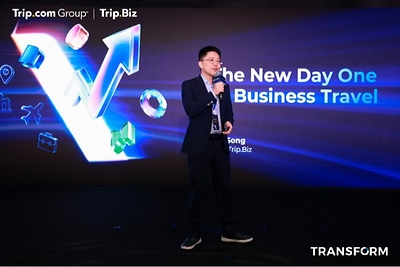
"Trip.Biz aims to become a leading global AI-powered travel management company (TMC) rooted in APAC and built for the complexity of global business travel", said Tao Song. "We are building for the new world, in which digital adoption pushes the boundaries of what's possible, and gives way to innovative tech solutions that help fix real-world challenges", he added.
Complexity Isn't the Region, It's the Model
For multinational travel, procurement and finance teams, APAC has long been treated as the exception that breaks the global travel program - a patchwork of markets with different regulations, payment standards, languages and supplier ecosystems.
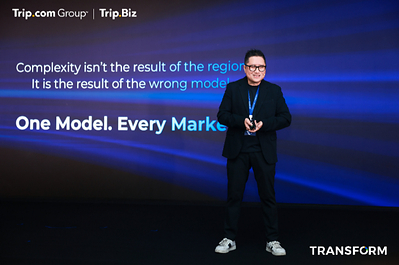
Trip.Biz's position, delivered in the event's keynote by General Manager, Southeast Asia Eugene Tan, is that this diagnosis is wrong. "The complexity isn't the APAC region, it's the model", Tan explained during his "Rethinking APAC as ONE" keynote. "Every model on the market today breaks somewhere, because none of them delivers consistency and depth at the same time."
The company points to three structural gaps that persist:
- Legacy TMCs offer deep local expertise, but execution depends on the local office involved, resulting in different standards in every market.
- Digital-only platforms are fast and familiar for routine bookings, but go silent the moment something isn't routine.
- In-house, self-managed programs offer full policy control, but no system to catch it when that control breaks down.
Each model delivers one piece of the puzzle, but gaps remain, costing global travel programs time, money, and control.
Trip.Biz's answer is a single, digital-first, full-service platform, designed to give global programs consistency across markets while absorbing the complexities of APAC - from contracting and settlement to entities and supplier ecosystems - rather than passing them on to the traveller or the program owner.
In practice, this means a single enforced service standard across every market, one consolidated view spanning booking, approvals, and reporting, and a consistent end-to-end experience. This consistency has delivered a 90% SLA compliance rate and an 80%+ satisfaction score across the region Trip.Biz serves.
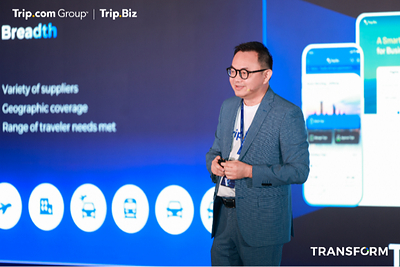
Product Director Terence Eng built on this during his "Closing Leakage with One Platform" keynote, stating that the model alone doesn't fully solve the problem, a challenge that extends across global travel programs. "Even with one platform, leakage doesn't disappear automatically," Eng said. "To actually reduce it, that platform needs the right content and genuinely good usability. Without both, travellers will still book off platform, even with the right model in place." Getting this right, Eng noted, is what ultimately increases adoption.
Launching Agent One: Built to Improve OBT Adoption and Fix Leakage
Trip.Biz CEO Tao Song took the stage to launch Agent ONE during his "Building Trust through Simplicity with Agent ONE" keynote, positioning it as the next step in closing the leakage gap. "A platform with the right content and usability gets you most of the way there", Song said. "AI is how we go further; by continuing to improve the user experience itself, we can drive an even higher adoption rate."
Agent ONE is a team of four connected, specialised agents supporting the end-to-end business travel lifecycle:
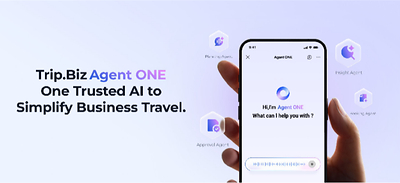
- Planning Agent: ends the multi-site search struggle. Drawing on a broader, multi-source range of content, it converts natural-language requests into personalised, policy-compliant recommendations, understanding traveller preferences, trip purpose, and itinerary logic to simplify search and boost online adoption.
- Booking Agent: replaces friction-heavy TMC booking flows with guided, conversational booking, keeping more trips inside the OBT. Early performance targets show average booking time dropping from around 45 minutes to 2 minutes, a +90% efficiency improvement, while keeping bookings natively connected to Trip.Biz inventory, pricing, approval, and payment.
- Approval Agent: auto-approves low-risk requests and routes only exceptions to human review, cutting approval wait times from over an hour to under 3 seconds.
- Insight Agent: goes beyond static dashboards to proactively surface hidden data patterns and actionable cost-saving opportunities, often missed due to rigid, fixed-view reporting. Insight Agent generates a full travel analysis report, complete with leakage patterns and savings opportunities, in under 7 minutes, a process that previously took analysts up to a week using legacy tools.
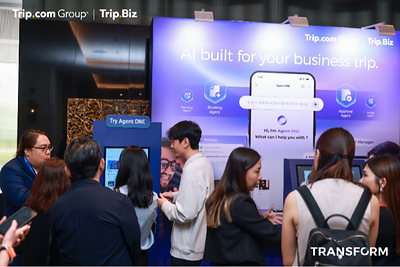
The real opportunity for AI is to remove the complexity travellers experience. When AI can understand what a traveller needs, find the right content, and automatically apply company policy, the managed program becomes simpler and more trusted. This helps drive greater adoption and reduce leakage, removing the complexity that has stood in the way of managed travel's original promise: one place for every trip. "Unlike generic AI assistants, Trip.Biz positions Agent ONE as a purpose-built AI solution", Song said. "We drive greater business efficiency across each stage of the business travel lifecycle, and help solve the practical challenge faced by our industry."
Trip.Biz positions the Agent ONE launch not as an incremental product update, but as a marker of how it intends to compete globally: combining the local depth required in complex markets with the consistency, simplicity and intelligence multinational travel programs increasingly expect worldwide. Agent ONE is now available globally across all Trip.Biz-supported markets.
END
About Trip.Biz
Trip.Biz, a digital-first full-service travel management company (TMC) powered by Trip.com Group, provides an all-in-one solution that streamlines business travel with human-centric technology and a people-first approach, offering extensive global content, exceptional service, and ESG solutions. As the fastest-growing TMC in the last few years, we have been trusted by over 15,000 multinational corporations and more than 1,000,000 small to medium-sized enterprises globally.
At Trip.Biz, we are dedicated to providing cost-effective and time-efficient travel solutions, empowering businesses to focus on what truly matters – growth and success. By saving on travel costs and time, our clients can invest more in their core operations and achieve their business outcomes.

 View original content to download multimedia:https://www.prnewswire.co.uk/news-releases/tripbiz-launches-agent-one-an-ai-suite-transforming-business-travel--cutting-booking-time-by-90-for-travellers-and-simplifying-oversight-for-travel-managers-302882323.html