Trinasolar Retains Tier 1 Status for Both PV Modules and Energy Storage Systems on S&P Global Cleantech Companies List 2026
CHANGZHOU, China, Aug. 27, 2026 /PRNewswire/ -- Recently, S&P Global released its second Tier 1 Cleantech Companies List, covering PV modules, PV inverters, wind turbines, energy storage systems, and energy storage battery cells. Trinasolar has once again been named as Tier 1 for both PV modules and energy storage systems. This consecutive inclusion recognizes Trinasolar's leading system integration capabilities, strong market presence, and commitment to sustainable practices.
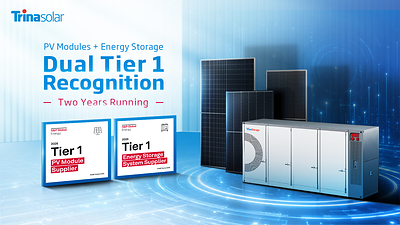
S&P Global Energy's Tier 1 Cleantech Companies classification evaluates global manufacturers across six key dimensions including market presence, market share, scale, global diversification, financial performance, and sustainability factors.
For 29 years, Trinasolar has been at the forefront of PV innovation. As a pioneer in n-type TOPCon industrialization, Trinasolar's Vertex N G3 module reaches a maximum power output of 760 W, offering high bifaciality, strong low-irradiance performance and reliability for utility-scale projects. At the same time, Trinasolar is advancing its THBC technology, forming a dual-engine model driven by both TOPCon and THBC across utility-scale and non-utility applications. By the end of 2025, Trinasolar's cumulative 210mm module shipments secured its position as the global No. 1. With customer-focused solutions for desert scenario and extreme climates, Trinasolar is also expanding into emerging fields such as AIDC, grid-forming energy storage and AI-powered distributed energy systems, ushering in a new era of scenario-based solutions.
TrinaStorage, as the company's strong second growth engine, has developed end-to-end energy storage capabilities across the entire Cell-to-Grid value chain. With sharp market insights and a robust global service network spanning 180+ countries and regions, by the end of 2025, TrinaStorage had shipped over 20GWh of energy storage systems across major markets including Asia-Pacific, Europe, Latin America, MEA, and North America, with signed overseas orders exceeding 10 GWh, further reinforcing Trinasolar's leadership in advancing the global clean energy transition.
Alongside its growing global presence, Trinasolar has made sustainability a core strategy, advancing the SOLAR sustainability management concept, strengthening environmental, social and governance practices, and driving supply chain collaboration to enhance product lifecycle performance. These efforts have been recognized by leading rating agencies, including S&P, Sustainable Fitch, BloombergNEF, and EcoVadis.
Looking ahead, Trinasolar remains committed to its mission of "Solar Energy for All," continuing to drive innovation and provide high-efficiency, reliable solutions that empower diverse applications and contribute to a net-zero future.
 View original content to download multimedia:https://www.prnewswire.co.uk/news-releases/trinasolar-retains-tier-1-status-for-both-pv-modules-and-energy-storage-systems-on-sp-global-cleantech-companies-list-2026-302861560.html