ASUS Expands AI Infrastructure Ecosystem from Cloud to Edge
Strategic collaborations with Intel and AMD help accelerate AI transformation
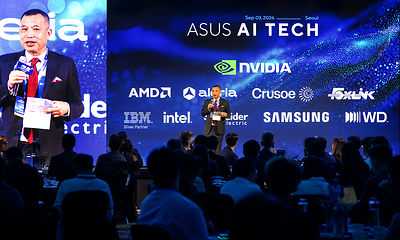
SEOUL, South Korea, Sept. 3, 2026 /PRNewswire/ -- At ASUS AI Tech 2026, ASUS today announced the expansion of its AI infrastructure ecosystem through strategic collaborations with Intel®, AMD, and a broader network of technology partners including Aleria, Foxlink, IBM, Samsung, Schneider Electric, and WD. The event shows how ASUS and its partners are driving AI innovation across the technology stack, accelerating AI adoption, and shaping the future of computing.
Advanced AI infrastructure powered by Intel and AMD
For broader enterprise and general-purpose applications, ASUS has a comprehensive AI infrastructure portfolio powered by Intel and AMD technologies that enable organizations to deploy diverse AI workloads across computing environments.
The showcase features the ASUS RS700-E12-RS4U and ASUS RS720-E12-RS12U, powered by Intel Xeon® 6 processors and designed as scalable computing platforms for AI, HPC, and data-intensive workloads. In addition, the XA P8I-E13A is a high-density 6U system featuring the Intel Xeon Next-Gen processor platform to support advanced GPU acceleration for demanding AI applications.
For AMD-powered solutions, the RS720A-E14B-R32U, RS500A-E14B-R12U, and ESC8000A-E13P are flexible, scalable platforms for enterprise and AI workloads. Featuring AMD EPYC™ 9006 Series server CPUs, the RS720A-E14B-R32U and RS500A-E14B-R12U provide optimized performance and efficiency for modern data centers and business applications. Equipped with AMD Instinct™ MI350P PCIe accelerators, the ESC8000A-E13P delivers scalable computing performance for inference, agentic AI, and high-performance computing workloads.
Bringing real-time AI intelligence to industrial edge applications
As AI moves beyond data centers and into real-world environments, organizations need reliable edge AI infrastructure to enable real-time intelligence across diverse applications, including transportation, public safety, manufacturing, and healthcare. Processing data locally, rather than sending it to the cloud, can help keep sensitive information such as patient records, production data, and video footage onsite. This approach ensures data confidentiality and meets compliance requirements in industrial and healthcare environments.
Unlike standard servers built for climate-controlled data centers, hardware deployed in varied environments such as factory floors, hospitals, and power plants must withstand extreme temperatures, unstable power, and electrical noise. Industrial edge computing therefore demands hardware engineered for wide temperature and voltage ranges, and offer ESD protection.
The ASUS Industrial Edge Server delivers enterprise-grade AI computing, rugged reliability, and long-term availability for applications such as factory automation, AOI, video surveillance, and healthcare. The new RUC-2000 series embedded computer is powered by Intel Core™ Ultra Series 3 processors with up to 180 AI TOPS, offering a rugged, fanless solution designed for machine vision, video analytics, and in-vehicle AI applications.
Advancing AI innovation from cloud to edge
ASUS remains committed to its vision of Ubiquitous AI, Incredible Possibilities, embedding intelligence across products, platforms, and partnerships. Through its expanding AI ecosystem, ASUS enables organizations to build, deploy, and scale AI solutions from cloud to edge to support the next era of intelligent computing.
AVAILABILITY & PRICING
ASUS servers are available worldwide. However, the availability of certain other ASUS products is subject to local regulatory requirements. For specific product availability and offerings in your region, please contact your local ASUS representative.
 View original content to download multimedia:https://www.prnewswire.co.uk/news-releases/asus-expands-ai-infrastructure-ecosystem-from-cloud-to-edge-302869211.html



