vivo Robotics Team Wins ICRA 2026 AGIBOT World Challenge Reasoning to Action Track
With top performance across two global challenges at ICRA 2026, vivo demonstrates the robustness and transferability of its robotics capabilities in real-world environments.
SHENZHEN, China, June 11, 2026 /PRNewswire/ -- vivo is proud to announce that the company's PrismBot robotics team won the Reasoning to Action Track at the ICRA 2026 AGIBOT World Challenge, held recently in Vienna as part of the IEEE International Conference on Robotics and Automation, a leading international robotics conference.
The vivo robotics team secured first place in the real-robot final with a decisive lead, demonstrating the strength of its technical approach in translating task understanding into action decisions in complex real-world environments. vivo advanced to the top in a highly competitive field that attracted 526 teams from across 27 countries and regions.
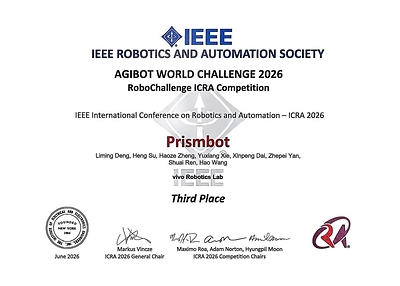
The vivo robotics team also received recognition for its strong performance in the Whole Body Control Track, ranking among the top three global teams, further underscoring the company's robust R&D and deep technical capabilities in embodied intelligence.
These results reflect vivo's broader strategy to build a perception system based on its imaging technologies and develop an AI-powered robot "brain" to help bring intelligent capabilities into the physical world, as outlined by Hu Baishan, President and COO at vivo, President of vivo Central Research Institute at the Boao Forum for Asia 2026.
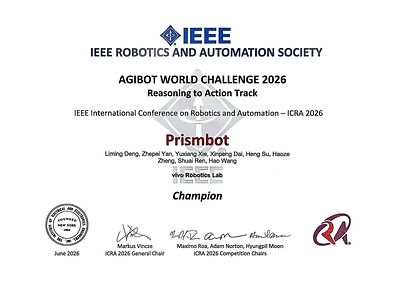
Integrated Intelligence and Execution Drive vivo's Reasoning to Action Track Win
The AGIBOT World Challenge, held as part of ICRA 2026, is one of the most demanding international competitions in embodied intelligence. The competition sets a high technical threshold, emphasizes real-world deployment, and uses rigorous real-robot testing to evaluate the performance of participating systems.
Its main competition, the Reasoning to Action Track, focuses on a core challenge in embodied intelligence: translating task understanding into action decisions. The track combines online simulation evaluation with offline real-robot testing in Vienna, with scoring based on task completion rates in real environments, long-horizon stability, and generalization across complex scenarios.
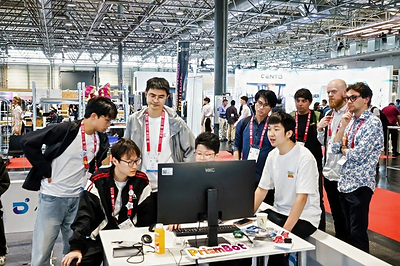
This innovative competition format moves beyond the industry's reliance on simulation data alone, focusing on bridging the gap between simulation and real-world deployment. Participating models must independently complete intent understanding, task decomposition, sub-goal sequencing, and exception recovery in real environments and then reliably translate the full decision-making process into physical execution through a robotic arm.
To address complex long-horizon tasks and real-world environmental interference, the vivo robotics team developed a training and inference framework centered on keyframe optimization and contrastive learning. Keyframe loss weighting helps the model learn critical action points more effectively, while contrastive learning significantly reduces the semantic gap between text-based instructions and physical action execution.
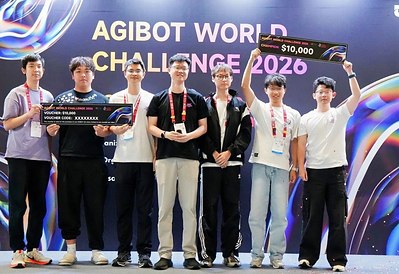
Top-Three Finish in Whole Body Control Track Validates the Transferability of vivo's Technical Approach
In the Whole Body Control Track held alongside ICRA 2026, robots were required to autonomously pick up specified products in a realistic supermarket scenario and accurately place them into a shopping cart. The track addresses real challenges in retail environments, including diverse product categories, changing spatial layouts, complex semantic understanding, instruction following, and action generalization.
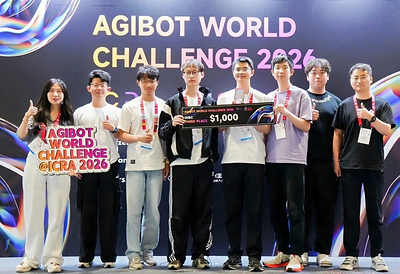
The vivo robotics team secured a top-three placement by successfully applying the same reasoning to action-centered technical system to the whole-body control scenario, using keyframe loss weighting to improve grasping accuracy and contrastive learning to better identify grasping directions.
The result further validates the transferability and engineering robustness of vivo's technical approach across different task types.
Defining the Next Generation of Smart Devices, Starting from the Home Environment
Competitions are a valuable testbed for technology and offer a glimpse into the next wave of innovation. Looking ahead to the evolution of smart devices over the next decade, vivo believes robots will become another important gateway for personal and household use after smartphones.
vivo has chosen the home as a starting point for its robotics research and development because home environments place high demands on long-horizon tasks, dual-arm collaboration, fine manipulation, reasoning, and decision-making. These capabilities closely align with those tested at ICRA 2026.
Focusing on home scenarios, the vivo robotics team is moving from teleoperation toward autonomous intelligence, gradually improving the executability and scalable validation of complex tasks. Building on its experience in device systems, imaging capabilities, and global product development, vivo is developing a robotics capability system that combines hardware and software and continues to evolve over time.
The ICRA 2026 awards mark an important milestone in vivo's long-term work in robotics. The next challenge is to bring embodied intelligence into everyday home environments. vivo will continue to invest in this field as it explores the next generation of smart devices and creates better user experiences through meaningful innovation.
(END)
About vivo
vivo is a technology company that creates great products based on a user-oriented value, with smart devices and intelligent services as its core. The company aims to build a bridge between humans and the digital world. Through unique creativity, vivo provides users with an increasingly convenient mobile and digital life. Following the company's core values, which include Benfen*, user-orientation, design-driven value, continuous learning, and team spirit, vivo has implemented a sustainable development strategy with the vision of developing into a healthier, more sustainable world-class corporation.
While bringing together and developing the best local talents to deliver excellence, vivo is supported by a network of R&D centers in Shenzhen, Dongguan, Nanjing, Beijing, Hangzhou, Shanghai, Xi'an and more cities, focusing on the development of state-of-the-art consumer technologies, including 5G, artificial intelligence, industrial design, imaging system and other up-and-coming technologies. vivo has also set up an intelligent manufacturing network (including those authorized by vivo), with an annual production capacity of nearly 200 million smartphones. As of now, vivo has branched out its sales network across more than 60 countries and regions and is loved by more than 500 million users worldwide.
*"Benfen" is a term describing the attitude on doing the right things and doing things right – which is the ideal description of vivo's mission to create value for society.
Stay informed of the latest vivo news at https://www.vivo.com/en/about-vivo/news
 View original content to download multimedia:https://www.prnewswire.co.uk/news-releases/vivo-robotics-team-wins-icra-2026-agibot-world-challenge-reasoning-to-action-track-302798117.html